·7 min read
Let's turn a browser task into a Playwright test
Record a browser task with Playwright, then add a saved-result check. Run the same test against broken and working saves.
playwrighttestingtypescript
Published: · 5 min read
Flaky tests destroy team confidence and slow deployment. Here are 10 proven strategies to eliminate flaky Playwright tests, from someone who's fixed thousands of them.

A flaky test is one that sometimes passes and sometimes fails without any code changes. They seem harmless at first, just re-run the pipeline, right?
Wrong. Flaky tests are silent killers:
The problem: CSS selectors and XPath break when developers change class names or restructure HTML.
The fix: Use Playwright's role-based locators:
Bad:
page.locator('#submit-btn')
page.locator('.form-container > button:nth-child(2)')
Good:
page.getByRole('button', { name: 'Submit' })
page.getByLabel('Email address')
page.getByText('Welcome back')
Role-based locators are more resilient because they target what users see, not implementation details.
**The problem: **waitForTimeout() is the number one cause of flaky tests.
await page.waitForTimeout(5000); // ❌ Please don't do this
Why it fails: 5 seconds might be enough on your machine but not in CI. Or it might be way too long, slowing tests unnecessarily.
The fix: Wait for specific conditions:
await page.waitForLoadState('networkidle');
await expect(page.getByRole('button')).toBeEnabled();
await expect(page.getByText('Success')).toBeVisible();
Playwright's auto-waiting handles most cases automatically. Trust it.
The problem: Tests depend on state from previous tests.
test('login', ...); // Creates session
test('add to cart', ...); // Expects logged-in state
If the login test fails, the cart test also fails, but not because of a cart bug.
The fix: Each test should set up its own state:
test.beforeEach(async ({ page }) => {
  await loginAsUser(page, 'testuser');
});
Or use Playwright's storage state to share authentication without dependencies:
await page.context().storageState({ path: 'auth.json' });
The problem: Clicking a button that's still loading, or reading text before it's rendered.
The fix: Wait for loading indicators to disappear:
// Wait for spinner to go away
await expect(page.getByTestId('loading-spinner')).toBeHidden();
// Then interact with the element
await page.getByRole('button', { name: 'Submit' }).click();
Or wait for the element to be in a specific state:
await expect(page.getByRole('button')).toBeEnabled();
await page.getByRole('button').click();
Strategy 5: Use data-testid for Dynamic Content
The problem: Elements generated dynamically have unpredictable locators.
The fix: Add data-testid attributes for testing:
In your application code:
<button data-testid="checkout-button">Checkout</button>
In your test:
await page.getByTestId('checkout-button').click();
This creates a contract between frontend and tests that survives refactoring.
The problem: A test fails once and you re-run the entire suite.
The fix: Use Playwright's built-in expect retries:
// playwright.config.ts
export default defineConfig({
  expect: {
    timeout: 10000, // Wait up to 10 seconds for assertions
  },
});
Assertions like toBeVisible() and toHaveText() will automatically retry until timeout, no manual retries needed.
The problem: API calls take longer in CI than locally.
The fix: Wait for network responses explicitly:
// Wait for specific API call to complete
await page.waitForResponse(resp =>
  resp.url().includes('/api/products') && resp.status() === 200
);
Or use networkidle for simpler cases:
await page.goto('/dashboard', { waitUntil: 'networkidle' });
The problem: Tests interfere with each other when running in parallel.
Test A creates user "testuser@example.com"
Test B also creates user "testuser@example.com"
One fails due to duplicate email.
The fix: Use unique data per test:
import { faker } from '@faker-js/faker';
const email = faker.internet.email();
await page.getByLabel('Email').fill(email);
Or isolate tests in separate browser contexts (Playwright does this by default).
The problem: You can't see what happened when a test failed in CI.
The fix: Enable traces on failure:
// playwright.config.ts
export default defineConfig({
  use: {
    trace: 'on-first-retry',
  },
});
Now, when a test fails and retries, Playwright captures:
npx playwright show-trace trace.zip
This is the single best debugging tool for flaky tests.
The problem: Default timeouts are too short for slow environments.
The fix: Configure appropriate timeouts based on your CI environment:
// playwright.config.ts
export default defineConfig({
  timeout: 60000,        // Test timeout: 60 seconds
  expect: {
    timeout: 10000,      // Assertion timeout: 10 seconds
  },
  use: {
    actionTimeout: 15000, // Click/fill timeout: 15 seconds
    navigationTimeout: 30000, // Page load timeout: 30 seconds
  },
});
Don't make them too long. Slow failures are frustrating. Find the right balance for your infrastructure.
When you encounter a flaky test, follow this process:
1. Reproduce locally
Run the test 10 times:
npx playwright test tests/checkout.spec.ts --repeat-each=10
If it passes every time locally but fails in CI, it's likely a timing or environment issue.
2. Check the trace
Open the trace file from CI and look for:
Common causes:
If you can't fix it after 30 minutes, delete it. A flaky test is worse than no test. You can always rewrite it properly later.
After applying these strategies on one project, we went from a 68% pass rate to 98%+ in three months.
Pass rate:
Before: 68%
After: 98.5%
Average test time:
Before: 4.2 minutes
After: 1.8 minutes
"Re-run pipeline" requests:
Before: Daily
After: Rare
Team trust in automation:
Before: Low
After: High
The biggest win wasn't technical. It was cultural. When tests are reliable, developers actually care about failures.
If your test suite is unreliable and slowing down your team, I can help. I've fixed test suites at Fortune 500 companies and can usually identify the main issues in just a few hours.
Get notified when I publish something new, and unsubscribe at any time.
·7 min read
Record a browser task with Playwright, then add a saved-result check. Run the same test against broken and working saves.
·5 min read
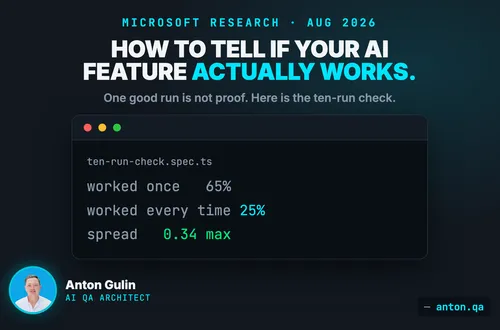
One good run is not proof. Microsoft measured a 40-point gap between working once and working every time. Here is the ten-run check, in Playwright, with code.
·4 min read
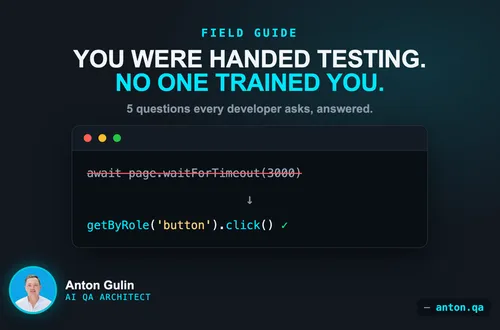
Shift-left made developers own testing. Here are the five questions every developer asks when handed Playwright, answered with code.