·3 min read
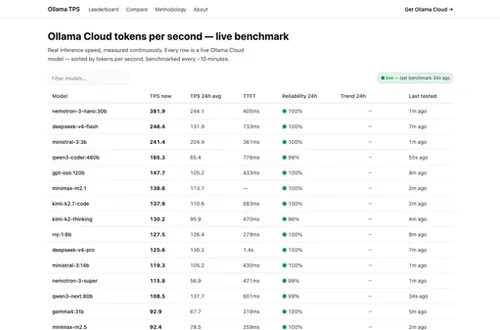
I measure how fast 42 LLMs actually answer. Here's the honest method.
An honest method for benchmarking LLM speed: tokens per second vs time to first token, across 42 Ollama Cloud models, measured every 10 minutes.
LLMbenchmarkingAI
Published: · 6 min read
An AI QA Architect designs the test systems AI agents run on. Learn the role, architecture, skills, and MCP testing boundary.

Last updated: 2026-05-25
An AI QA Architect designs the test system AI agents run on. They connect requirements, test generation, browser execution, evidence, and human review. The job keeps QA engineers in control. It gives agents a safe place to create, run, fix, and explain tests.
QA means quality assurance.
AI QA Architect is a system role.
It is not a tool title.
The person owns the way AI touches quality work.
That includes the rules, the evidence, and the release gate.
An AI QA Architect is responsible for the test architecture behind AI-assisted quality work.
Architecture means the system design.
It answers five questions:
The role matters because AI drafts tests fast.
Fast tests are not enough.
You need a system that catches weak tests before they land.
You also need evidence humans can review.
Most QA systems were built for humans first.
A person read the ticket.
A person chose the test.
A person checked the failure.
A person decided if the release was safe.
AI changes the speed of that loop.
An agent can draft a test from a ticket.
It can inspect a failing trace.
It can suggest a fix.
It can explain a failure.
That power creates a new risk.
If the system has weak gates, AI makes weak work faster.
If the system has strong gates, AI can help the team move safely.
That is the AI QA Architect's job.
The agent needs clean input.
Input can be a user story, bug report, ticket, or spec.
The architect defines what good input means.
A good input names:
Without this, the agent guesses.
Guessing creates noisy tests.
AI can draft tests.
Humans still review them.
A good generation flow has rules.
It tells the agent:
This keeps generated tests inside the team's standards.
Execution means running the test.
For browser checks, tools like Playwright matter.
They produce traces, screenshots, reports, and browser state.
Those artifacts become receipts.
Receipts are proof a human can review.
AI agents need receipts too.
Without receipts, the agent only has text.
A failed test is not enough.
The system must answer:
AI can help sort the evidence.
The human still owns the decision.
A release gate decides what ships.
CI means server test runs.
The gate uses CI results, test reports, and risk rules.
An AI QA Architect defines the gate.
They decide which failures block release.
They decide which failures need review.
They decide what evidence is required.
QA automation asks, "Can we run the test?"
AI QA architecture asks, "Can we trust the system around the test?"
That includes automation.
It also includes agents, prompts, data, evidence, review, and release rules.
A QA automation engineer may build the runner.
An AI QA Architect owns the full loop.
MCP means Model Context Protocol.
It is a standard way for AI tools to connect with external tools.
MCP testing has two jobs.
First, test the MCP server you build.
That means tools, resources, prompts, and errors.
Second, test software through MCP-enabled tools.
That means the agent can call a browser, database, or API tool.
Both jobs need a test system.
The official MCP Inspector helps developers test MCP servers.
It gives a visual way to inspect capabilities and debug requests.
That is useful.
It is not the full QA system.
The architect still defines the rules around safe use.
You need test automation depth.
You need enough AI knowledge to set safe boundaries.
You need architecture judgment.
Core skills:
LLM means language model.
You do not need to train one.
You do need to know how it fails.
It can hallucinate.
It can skip edge cases.
It can accept weak evidence.
Your system must catch those failures.
An AI QA Architect is not a person who buys AI tools.
It is not a person who tells testers to stop writing tests.
It is not a person who trusts every generated test.
The role is more practical.
You design the system so agents can help safely.
You protect the human decision.
You make quality visible before release.
Use this before adding AI to a test suite.
If the answer is no, fix the system first.
An AI QA Architect designs the test system AI agents use. They define how agents read requirements, generate tests, run checks, and produce evidence. The goal is safer test automation with human review.
No. The role protects human review. AI agents can draft tests and inspect failures. Humans still own the quality decision. The architect designs the rules around that work.
AI test automation architecture connects human intent, AI assistance, test execution, evidence, and release gates. It includes prompts, tools, CI, reports, data, and review rules.
MCP testing covers two jobs. You test MCP servers you build, and you test software through MCP-enabled tools. Both need clear inputs, safe tool access, and evidence a human can review.
Build the evidence loop first. Every test failure should show action, page state, assertion, logs, and release impact. Then add AI help inside that loop.
AI QA Architect is a system owner.
The job is not to make AI look smart.
The job is to make quality safer when AI joins the loop.
Start with evidence.
Add agents after that.
Anton Gulin is the AI QA Architect, the first person to claim this title on LinkedIn. He builds AI-powered test automation systems where AI agents and human engineers collaborate on quality. Former Apple SDET (Apple.com / Apple Card pre-release testing). Find him at anton.qa or on LinkedIn.
Get notified when I publish something new, and unsubscribe at any time.
·3 min read
An honest method for benchmarking LLM speed: tokens per second vs time to first token, across 42 Ollama Cloud models, measured every 10 minutes.
·5 min read
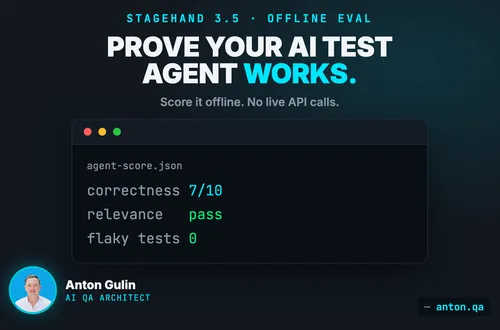
Learn how to score the tests an AI agent writes. Record the run as a trajectory, replay it offline, and grade it without live API calls.
·3 min read
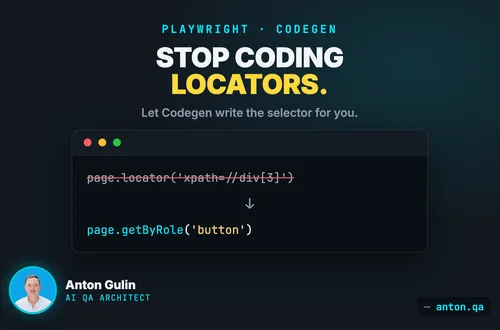
Learn how to generate clean test scripts using Playwright Codegen, and how to scale those drafts into a production-ready test architecture.